


Packaging is not only about content. Today, packaging boxes can affect the safety of products, shipment efficiency, sustainability and customer perception regarding your brand. The type of box selected directly impacts cost, protection and customer experience as well.
With the increasing competition in the packaging sector, companies should know the kind of packaging boxes offered and the performance of each in the actual events of the usage. Lightweight retail cartons to medium and heavyweight corrugated boxes, each type of the packaging process has its role in the contemporary process of packaging.
This guide disaggregates the most popular box types, materials and structure, and assists you in finding the correct packaging material, logistics requirements, and brand values.
Section 1: Core Types of Packaging Boxes & Materials
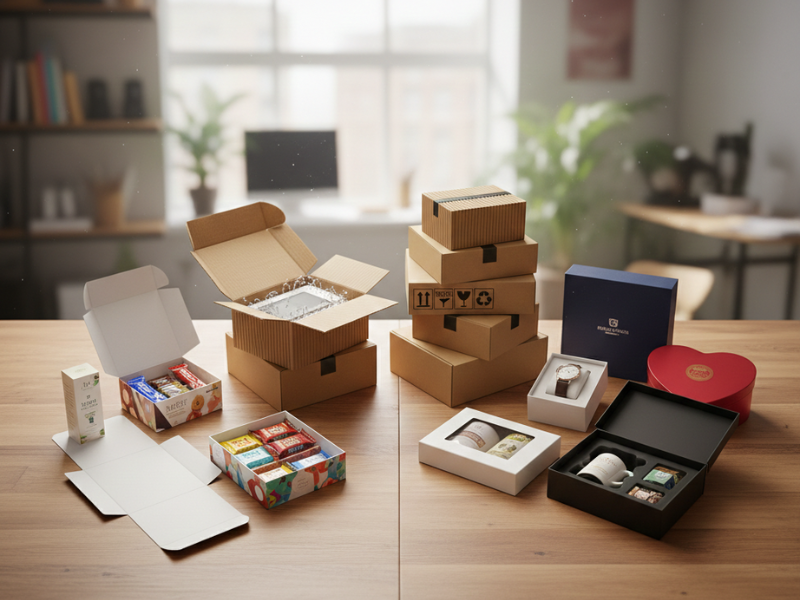
Folding Cartons (Paperboard Boxes)
Folding cartons are lightweight and made of paperboard thin packaging boxes which are popular in retail packaging. A common use for them is in cosmetics, food products, pharmaceuticals, and small consumer products.
The boxes are flat, easy to assemble and can support quality printing, thus being suitable to use in branding oriented product packaging. They are a common box type that is widely used in the retail stores due to their efficiency.
Nonetheless, the folding cartons have low structural strength and cannot hold heavy or delicate items unless combined with inserts or a box.
Corrugated Boxes (Corrugated Fiberboard / Cardboard Boxes)
The modern logistics and shipping boxes are based on corrugated boxes. They are constructed out of corrugated fiberboard, which is composed of a fluted core (lentic) enclosed between liners.
The corrugated cardboard boxes are great in fragile products, volume and eCommerce deliveries due to the cushioning, strength and shock-absorbing properties of this structure. The fluted core is made with rigidity and not too much weight.
According to the Sustainable Packaging Coalition, corrugated packaging remains one of the most efficient and recyclable paper-based shipping solutions
Rigid Boxes (Set-Up Boxes / Hard Paper Packaging)
Rigid boxes are high-quality packaging boxes that are created out of sturdy chipboard or paperboard that cannot be folded up. These boxes are also durable, and have a luxurious feel as they do not lose their shape.
Their usage is mostly based on luxury products, electronics, company gifts, and luxurious retail products in which the presentation is a concern. A hard packaging can be incorporated into the product experience and provide a high end unboxing experience.
Rigid boxes are also more costly to deliver than folding cartons or corrugated boxes since the former is pre-assembled, which occupies more space in the warehouse and follows the shipping cost pattern.
Hybrid & Specialty Packaging
Hybrid packaging involves the use of structural components of various kinds of boxes. These are sleeve-and-tray designs, magnetic-lid rigid boxes, window cartons and design style trays.
These are solutions that are frequently employed whereby standard formats may not fit protection or presentation needs. Limited edition, subscriptions or products that need an enhanced level of protection and appearance would best be packaged in specialty boxes.
Other Paper-Based Packaging Materials
In addition to the box formats, the packaging can be done using layered paperboard, kraft paperor using multi-layer corrugated board based on the performance requirements. The use of paper-based options prevails as there is recycling and versatility.
There are also non-paper alternatives such as wood crates or plastic containers, however the present guide is oriented on the use of paper-based packaging boxes as they are the dominant in the present-day supply chains because they are more sustainable and cost-efficient.
Section 2: When to Use Each Box Type
Effective packaging design also plays a major role in e-commerce success. According to Shopify’s guide on packaging design for retail and e-commerce, well-structured boxes help protect products during transit while enhancing the customer’s unboxing experience. For online brands, choosing the right packaging box directly impacts customer satisfaction and repeat purchases.
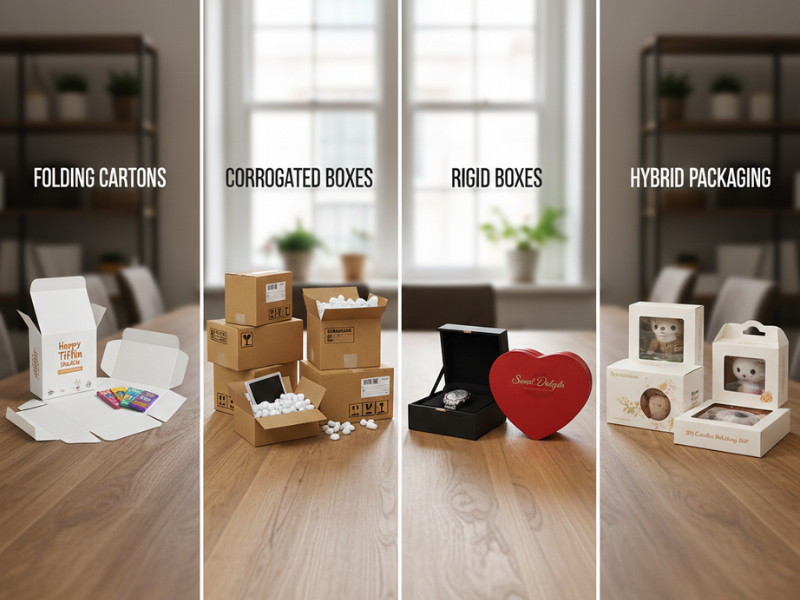
Choosing the right box depends on product weight, fragility, shipping method, and branding goals. The table below summarizes how different types of packaging boxes perform in real-world applications.
| Box Type | Best Used For | Strengths | Limitations |
|---|---|---|---|
| Folding Cartons | Lightweight retail goods | Low cost, great branding | Limited protection |
| Corrugated Boxes | Shipping, storage, eCommerce | Strong, stackable, protective | Less premium appearance |
| Rigid Boxes | Premium retail, gifts | Durable, high perceived value | Higher cost |
| Hybrid Boxes | Specialty or fragile products | Custom fit, tailored design | Complex production |
Understanding these trade-offs helps businesses select packaging boxes that align with logistics and customer expectations.
Section 3: Corrugated Box Styles Explained
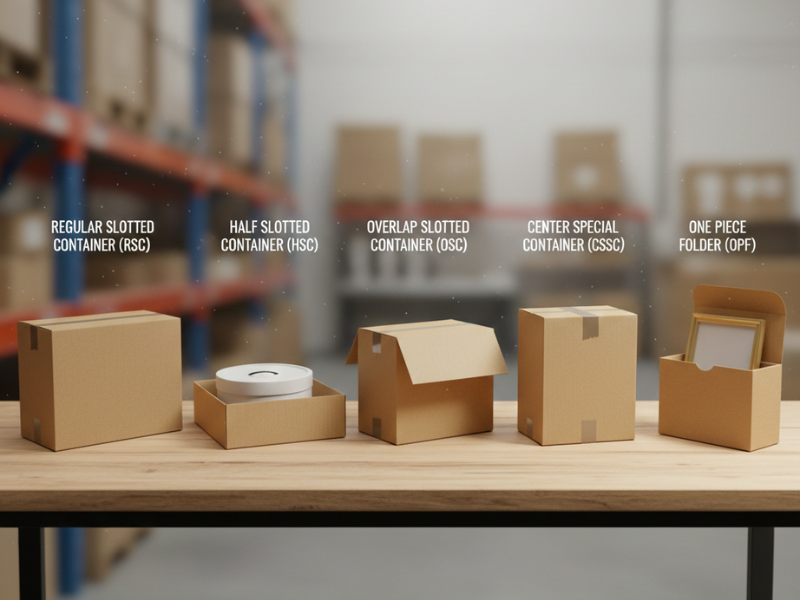
Not all corrugated boxes are the same. Their design depends on flap structure, wall thickness, and closure method.
Regular Slotted Container (RSC)
The most widespread type of corrugated box is the regular slotted container. Every one of the flaps is equal in length and the outer ones intersect at the center when closed.
RSCs are inexpensive, simple to produce and commonly come in as a standard cardboard box to ship and store.
Half Slotted Container (HSC)
A half slotted container has flaps on only one side. This design is often used as a display tray or inner pack inside a master carton.
HSCs are useful when products need easy access while still benefiting from corrugated cardboard strength.
Overlap Slotted Container (OSC)
The outer flaps are made to overlap one another in an overlap slotted container. This closed overlap design offers additional protection and enhanced stacking ability.
OSC boxes are advised in case of heavy or delicate objects or intercity shipment in which the longevity is a consideration.
Center Special Slotted Container (CSSC)
A center special slotted container features outer flaps that meet at the center without overlapping, while inner flaps are shorter.
This style reduces material usage while maintaining adequate protection for moderate-weight products.
One Piece Folder (OPF)
The product is covered with a one piece fold that is made by wrapping a single sheet of corrugated material. The top-flaps and the bottom-flaps are folded over the product.
OPFs suit flat objects such as books, frames, or even panels which do not require depth of protection but just surface.
Section 4: Material Considerations & Structural Differences
Packaging design plays a critical role in how customers perceive product quality and brand value. According to research on packaging and consumer behavior, packaging directly influences purchasing decisions by shaping first impressions and trust. This makes choosing the right box structure and material a strategic business decision, not just a logistical one.
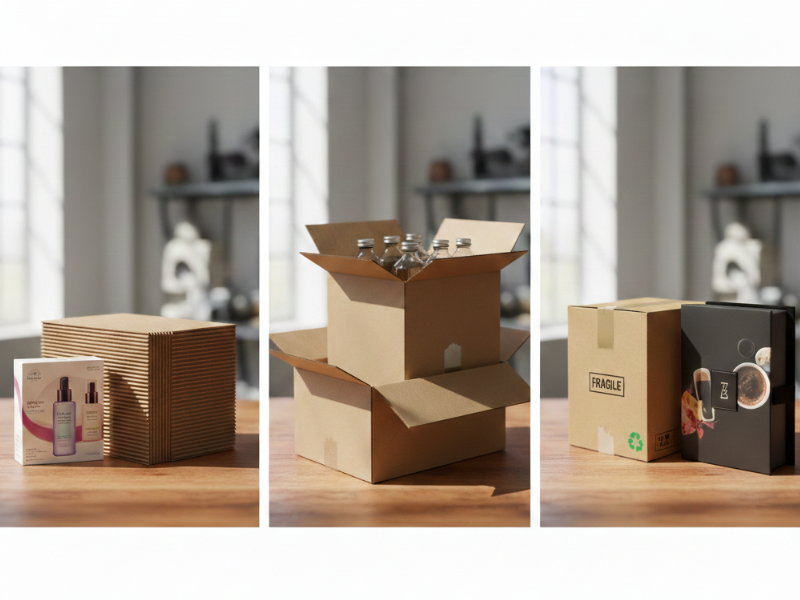
Paperboard vs Corrugated Cardboard
Paperboard, which is used in folding cartons, is thin and smooth thus it is good in branding but not strong in shipping. Cardboard is made with a fluted core to strengthen it.
Corrugated construction is able to increase the thickness of the packaging without increasing the weight which enhances protection during transit.
Single-Wall vs Double-Wall Corrugated Boxes
Single-wall boxes use one fluted layer, while double-wall options add an extra layer of fluting for heavier loads.
Double-wall corrugated boxes are used when shipping fragile items, glass bottles, or industrial goods requiring enhanced durability.
Protection & Durability
For shipping boxes, corrugated or rigid structures provide the most protection. Folding cartons are better suited to in-store display or secondary packaging.
Selecting the wrong structure increases damage risk and hidden costs like returns and replacements.
Branding & Presentation
Premium printing and finishing methods are supported by rigid boxes and paperboard cartons whereas corrugated boxes pay more attention to functionality.
Nevertheless, with developments in print technology, brands can be printed on corrugated fiberboard to facilitate ecommerce shipping package and subscription boxes.
Sustainability Considerations
Paper-based packaging boxes are widely recyclable, especially when made from recycled materials. According to National Geographic’s sustainable packaging analysis, paper packaging offers strong end-of-life benefits compared to plastic
Section 5: Packaging Box Types & Selection FAQs
What’s the difference between cardboard and corrugated boxes?
Cardboard is a general term in reference to the paper-based packaging materials whereas corrugated cardboard boxes have a fluted inner layer that gives it strength and cushioning. This multi-layered design enables the corrugated boxes to sustain shipping pressures, stacking, and impact much better.
When should I choose rigid boxes?
Premium or fragile products are best packaged in rigid boxes because both presentation and durability are also of great significance. They provide premium appearance, high level of protection and in most cases opposite to the use, they are reused by the customers which comes with long term brand value.
Are folding cartons suitable for shipping?
Folding cartons are not the best when it comes to shipping, individual folding cartons offer minimal protection. When transporting, they are to be supplemented with corrugated boxes or protective inserts in order to avoid damage.
Can one box type meet all needs?
Rarely. Most businesses rely on multiple types of packaging boxes to support retail display, shipping, and storage. The right choice depends on product weight, fragility, and how the item is delivered to customers.
How do I balance cost and protection?
Begin by considering product risk, shipping distance and handling conditions. Then match your packaging option with both price and the degree of protection and display your brand needs.
Conclusion
Packaging boxes cannot be generalized with a single solution. The optimal option will be based on what you are selling, shipping method and how customers will perceive your brand.
Knowing the dissimilarity of folding cartons, corrugated boxes, rigid boxes, and specialty formats, it enables the businesses to select a packaging that is economical, protective, sustainable, and presentable.
Using the right packaging makes the products undamaged and creates a memorable impression.
Call to Action
Need help selecting the ideal box for your product?
Review your product type, shipping needs, and brand positioning, then choose from folding cartons, corrugated shipping boxes, or premium rigid packaging.
👉 Visit itendee.com to request a quote or explore custom packaging boxes designed to protect products and elevate brand experience.
Partner with Tandee, your trusted packaging manufacturer, supporting scalable and sustainable packaging solutions worldwide.


